
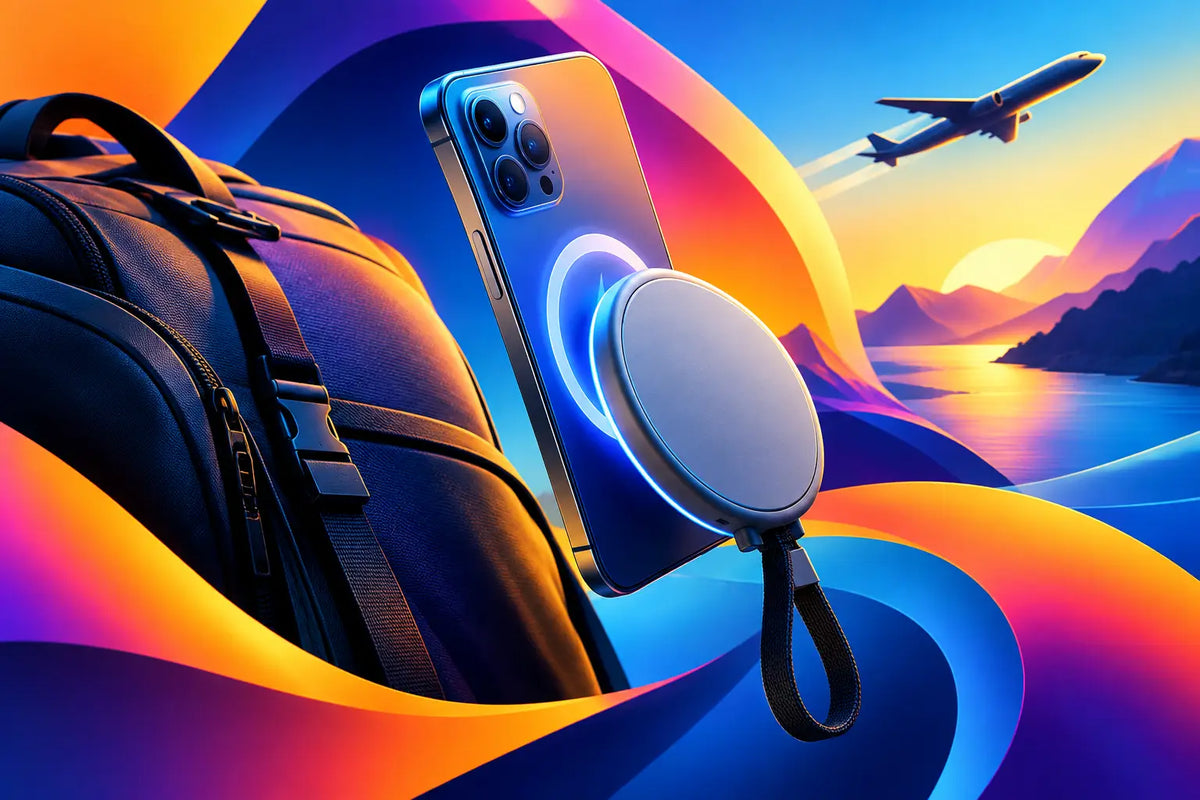
Your boarding pass is in your Wallet, your gate changed twice, and your battery is sitting at 14%. That is exactly when MagSafe travel charging earns its spot in your bag. A magnetic power bank gives your iPhone a fast, cable-light backup without turning your airport seat, hotel nightstand, or rental-car console into a knot of cords.
For travelers who want their tech to look as good as the rest of their packing list, the right setup is not about bringing every charger you own. It is about carrying a compact system that works with your phone, your case, and the outlets you are likely to find.
Why MagSafe travel charging makes packing easier
A standard charging kit often grows by accident: wall brick, USB cable, backup battery, extra cable for the backup battery, and a case that has to come off before anything magnetic will work. MagSafe cuts down the friction. The power bank snaps onto the back of a compatible iPhone, leaving the charging port open for wired charging or headphones if you need them.
That magnetic hold matters most when you are moving. You can answer a message while charging in a rideshare, check a map while walking through a terminal, or hold your phone during a delayed-flight scroll session without balancing a dangling cable. It feels small until you are trying to charge from the one outlet behind a crowded airport chair.
There is a trade-off, though. Magnetic wireless charging creates more heat than a good wired connection and is usually slower, especially if you are actively using your phone. Think of a MagSafe battery as your all-day insurance policy, not always your fastest route from 5% to 100%.
Build a travel setup around your actual trip
The best charging setup for a two-day city break is different from what you need for a week of flights, trains, and work calls. Start with the moments when your phone is most likely to run low. Navigation, mobile boarding passes, concert tickets, camera use, and hotspot duty drain a battery much faster than an ordinary day at home.
For weekend trips and day events
A slim MagSafe power bank is often enough. It is easy to carry in a jacket pocket or small crossbody bag, and it gives you a useful top-up before dinner, a show, or the trip back to your hotel. Pair it with one compact USB-C wall charger for overnight charging, and you have a clean, low-bulk setup.
If you are using your phone constantly, do not wait until the battery is nearly empty. Attach the power bank when you are around 30% to 50%. Charging in that middle range usually keeps your phone cooler and gives you more flexibility later.
For long-haul flights and busy itineraries
Bring both a magnetic power bank and a USB-C cable. Your MagSafe battery is ideal when you are in transit, but a cable is still the smarter choice when a wall outlet is available and time is short. Wired charging is generally quicker and produces less heat, which is useful after a long day of photos, navigation, and video.
This two-part approach also gives you a backup if one piece gets misplaced. It is not glamorous, but travel gear should have a plan B. Keep the cable and wall charger in the same small pouch so they do not disappear into the bottom of your bag.
For international travel
Check the plug style at your destination before you leave. A MagSafe battery itself does not need an outlet while it is charging your phone, but it still needs to be recharged eventually. A compact travel adapter and a USB-C wall charger can cover the basics without adding a pile of bulky adapters.
Airline rules matter, too. Lithium-ion power banks should travel in your carry-on, not checked luggage. Capacity limits can vary by airline and destination, so confirm the policy before packing. A power bank that stays in your personal item is also far more useful than one sitting in a suitcase below you.
Your case can make or break the magnetic connection
A magnetic charger is only as dependable as the surface it attaches to. MagSafe-compatible cases include a built-in magnetic ring aligned with the charging coil, helping the power bank snap into the correct position and stay put. This is especially valuable when you are walking, commuting, or pulling your phone in and out of a bag all day.
A thick non-magnetic case can weaken the hold, shift the charger out of alignment, or make charging inconsistent. Some cases may allow a connection, but the power bank can slide more easily and heat up faster. If you have ever found your battery pack attached at a weird angle with no charge actually going into your phone, alignment is probably the issue.
Style should not be the compromise here. A bold case can still be travel-ready when it is designed for magnetic accessories. CASETEROID MagSafe-compatible cases are made for the people who want a protective case with personality, plus the freedom to snap on a power bank when the day runs longer than planned.
How to get more charge from a MagSafe power bank
Wireless charging is convenient, but it rewards smart habits. You do not need to baby your battery pack. A few simple choices can make it work noticeably better while you travel.
First, keep the phone and power bank as cool as possible. Avoid charging in direct sun, on a hot dashboard, or under a pillow at your hotel. Heat can slow charging and may cause the phone to pause temporarily to protect its battery. If your phone feels warm, take off the power bank for a few minutes and let both devices cool down.
Second, check the attachment before tossing your phone into a pocket or bag. The magnets should feel centered and secure, with the battery sitting flat against the case. A loose connection wastes energy and can leave you with a nearly drained power bank but less charge than you expected.
Third, use Low Power Mode when you are relying on a portable battery for the rest of the day. Turn down screen brightness, pause unnecessary background activity, and use downloaded maps or playlists when possible. The goal is not to make your phone less useful. It is to save power for what matters, whether that is finding your hotel or capturing the view from the rooftop.
Choose capacity based on convenience, not just the biggest number
A larger power bank can hold more energy, but it will also add weight and thickness to your phone. For some travelers, that is a fair trade. If you are shooting video, using a hotspot, or spending full days away from outlets, extra capacity is worth carrying.
For everyone else, the best choice is often the one you will actually bring. A sleek magnetic battery that fits your everyday bag is more useful than a giant pack left in your hotel because it feels too heavy. Look for a shape that sits comfortably on your phone and does not block your camera when attached.
Also pay attention to the battery pack's own input charging. USB-C charging is a practical choice because you may already carry a USB-C cable for your phone, tablet, earbuds, or laptop. Fewer cable types means fewer things to replace at an airport store.
A better way to pack your charging gear
Give your charging accessories one home. A small zip pouch, interior bag pocket, or dedicated compartment prevents the familiar travel panic of knowing you packed a cable but not knowing where. Put your wall charger, cable, adapter, and magnetic battery together before leaving for the airport.
Charge the power bank fully the night before, then check it again before heading out. If it has indicator lights, learn what they mean before you are stuck at 8% in a terminal. It sounds obvious, but an uncharged power bank is just extra weight with excellent design.
The most useful travel tech does not demand attention. It fits your style, handles the unpredictable parts of your day, and keeps your phone ready when the itinerary changes. Pack a MagSafe-compatible case and a charged magnetic battery, then spend less time hunting for outlets and more time being where you came to be.
Phone Accessory Trends Worth Wearing in 2026
How to Remove Stains From Phone Cases Safely