
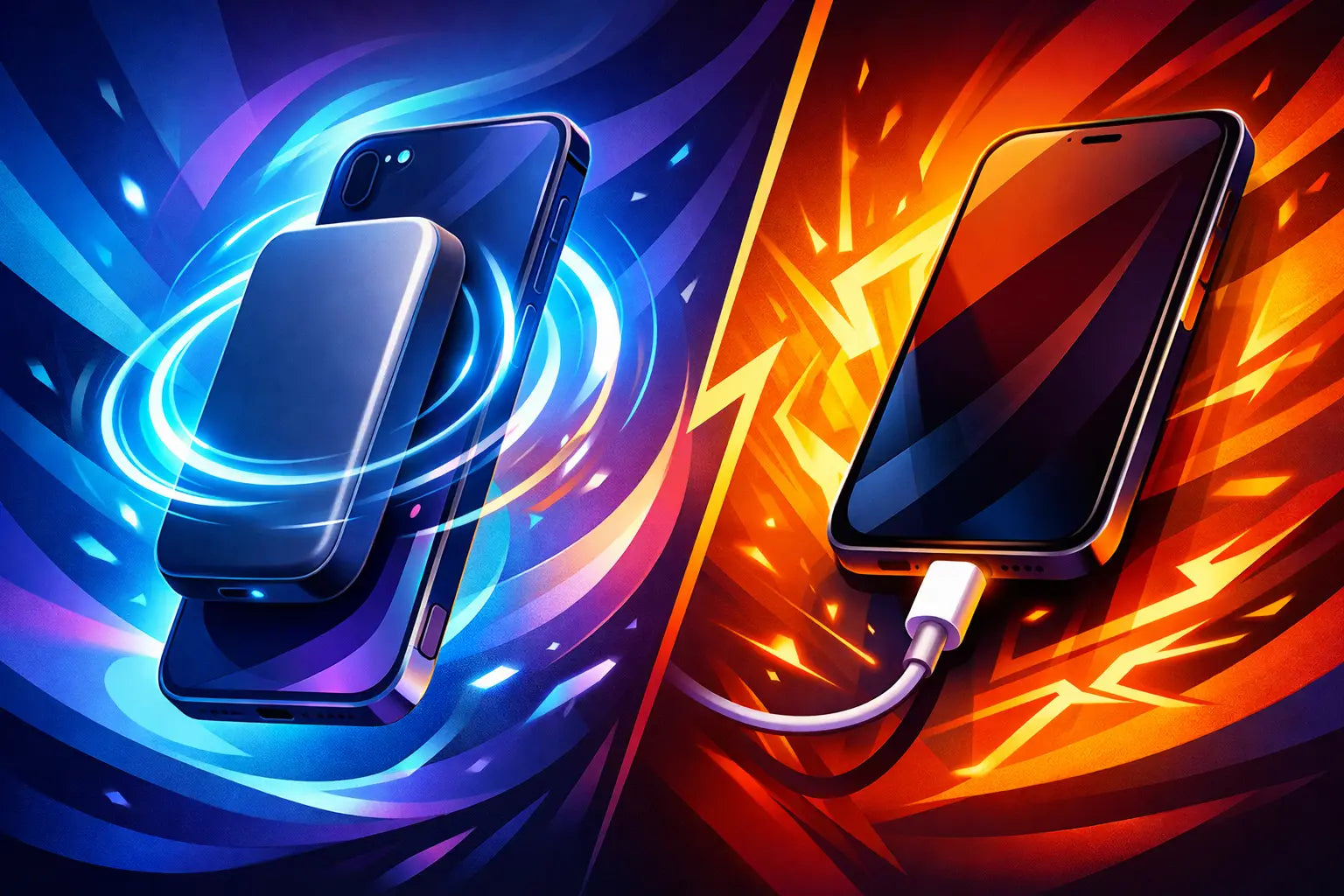
Your phone is at 12%, your group chat is blowing up, and the rideshare app is still loading. That’s the moment when MagSafe power bank vs wired charger stops being a spec-sheet question and becomes a real-life decision. Do you snap a battery pack onto the back and keep moving, or plug in and get the fastest charge possible?
For most people, the answer is not one-size-fits-all. A MagSafe power bank wins on freedom and convenience. A wired charger usually wins on raw speed and efficiency. The better choice depends on how you use your phone, how often you’re out, and whether you care more about charging while scrolling or getting back to 80% as fast as possible.
MagSafe power bank vs wired charger: what really changes?
On paper, both options do the same job. They recharge your phone. In practice, they create very different experiences.
A wired charger is the classic move. Plug in, get power delivered directly, and usually charge faster with less energy loss. If you’re sitting at a desk, in bed, or at an airport gate, wired charging is hard to beat.
A MagSafe power bank is built for motion. It attaches magnetically to the back of compatible iPhones, so you can charge without dealing with a cable hanging off the bottom of your phone. That sounds like a small upgrade until you’re texting, filming, commuting, or using maps while topping up your battery. Then it starts to feel like a lifestyle feature, not just a charging method.
Speed matters, and wired usually wins
If your only goal is to refill your battery quickly, wired charging is usually the better bet.
That comes down to how power is transferred. With a cable, energy flows directly into the phone with less waste. Wireless charging, including MagSafe-style charging, loses more energy as heat. That means charging can be slower, especially if you’re actively using your phone at the same time.
This is the part people notice most on busy days. A wired charger is better when you have 20 minutes before heading out and need a serious battery boost. It’s also more reliable for heavier users who stream, game, edit video, or run multiple apps all day. If your battery habits are chaotic, a cable is usually the fastest recovery plan.
That said, faster is not always better in every situation. If you’re walking around, holding your phone, or moving between places, a wired setup can be awkward. Speed loses some shine when your phone is tethered to a wall or dangling from a portable battery by a cable that keeps getting bent in your pocket.
Convenience is where MagSafe stands out
This is where the magnetic power bank earns its hype.
A MagSafe power bank snaps into place and stays aligned, which is a big upgrade over older wireless charging that could be finicky. You don’t need to line your phone up perfectly on a charging pad or carry an extra cable just to use a portable battery. It’s quick, clean, and easy to toss on when your battery starts slipping.
For a lot of people, that convenience changes charging habits for the better. Instead of waiting until 5% and panicking, you can top up at 60%, 45%, or 30% while you’re still using your phone. That light, steady boost through the day can feel more practical than one big charge session.
It also looks better. Let’s be honest - a magnetic battery pack feels more put together than a cable snake wrapped around your phone on the train. If your accessories are part of your style, this matters. Tech doesn’t have to look messy to be useful.
Heat, efficiency, and battery wear
This is the less glamorous part of the conversation, but it matters.
Wired charging is generally more efficient, which means less wasted energy and often less heat. Wireless charging can create more warmth, especially if the phone and battery pack are both working hard. Heat is not great for long-term battery health, and while modern phones manage it pretty well, it’s still something to think about if you charge this way constantly.
That doesn’t mean MagSafe is bad for your phone. It means moderation and quality matter. A well-made magnetic power bank with proper alignment and sensible output is very different from a cheap accessory that runs hot and charges inconsistently. If you use a MagSafe power bank for top-ups during the day and rely on wired charging when you need speed, that’s a pretty balanced setup.
Portability depends on how you move
If you’re always on the go, portability is not just about size. It’s about how easy something is to actually use.
A wired charger can be tiny, but it usually comes with extra pieces. You need a cable, and sometimes a wall adapter, and if you’re using a portable wired battery, you still have to manage the cable while your phone charges. That setup works best when you can set your phone down or leave it in one place.
A MagSafe power bank is easier to use while moving. You attach it and keep going. It’s ideal for commuters, travelers, students walking across campus, festival people, content creators, and anyone who uses their phone heavily outside the house. You don’t have to choose between charging and using your phone normally.
There is a trade-off, though. Magnetic battery packs add bulk to the back of your phone. Some are slim and stylish, others feel chunky. If you care about the way your phone feels in hand, the design of the power bank matters a lot. A good one should feel secure without turning your phone into a brick.
Cost and value are not the same thing
Wired chargers are usually the more budget-friendly option. You can get fast charging without spending much, and if you already own cables and adapters, the cost is even lower.
MagSafe power banks tend to cost more because they combine portability, magnets, wireless charging tech, and design. But price alone doesn’t tell you which one is the better value.
If you only charge at home, a wired charger gives you more practical value. If you’re constantly out and your battery anxiety is real, a magnetic power bank can earn its place fast. Paying more for something you actually use every day makes sense. Paying less for something that lives in a drawer does not.
For style-conscious buyers, value also includes how the accessory fits your setup. A sleek MagSafe-compatible battery that looks good with your case and feels intentional can be worth more than a cheap charger that gets the job done but kills the vibe.
Which one fits your daily routine?
The easiest way to decide is to stop thinking like a reviewer and start thinking about your own day.
If you work from a desk, charge overnight, and mainly need quick battery recovery before heading out, wired charging is probably your best main option. It’s faster, simpler, and more efficient.
If you’re out for long stretches, use navigation, film content, scroll constantly, or hate being attached to a cable, a MagSafe power bank makes more sense. It turns charging into something passive and flexible instead of something that interrupts your routine.
A lot of people will do best with both. Wired for speed at home. MagSafe for freedom when you’re out. That combo covers almost every scenario without forcing one charger to be perfect at everything.
MagSafe power bank vs wired charger for cases and compatibility
This part gets overlooked, but it matters if you use a case every day.
Wired charging is usually less picky. As long as your charging port is accessible and your cable fits properly, you’re good. MagSafe charging depends on magnetic alignment, so your case needs to be compatible. If the magnets are weak or the material is too thick, the connection can be less secure and charging can be less reliable.
That’s why a well-designed MagSafe-compatible case makes a difference. It helps the battery pack snap on correctly, stay in place, and work the way it should. With the right setup, the experience feels clean and easy instead of fussy. CASETEROID leans into that sweet spot where protection, style, and MagSafe function all work together, which is exactly what you want if your accessories need to look good and perform.
The better charger is the one you’ll actually use
There’s no dramatic winner here, just a clearer match for different habits. Wired charging is still the speed king. MagSafe power banks own convenience, portability, and everyday flexibility.
If your battery routine is mostly static, go wired. If your phone is basically an extension of your hand and you’re rarely sitting still, magnetic charging has serious appeal. And if you want the smartest setup, use each one where it shines.
The best charging accessory is not the one with the loudest specs. It’s the one that fits your life well enough that you never have to think twice about whether your phone will make it through the day.
Phone Case With Strap for Commuting
Hard Case vs Soft Case: Which Wins?