
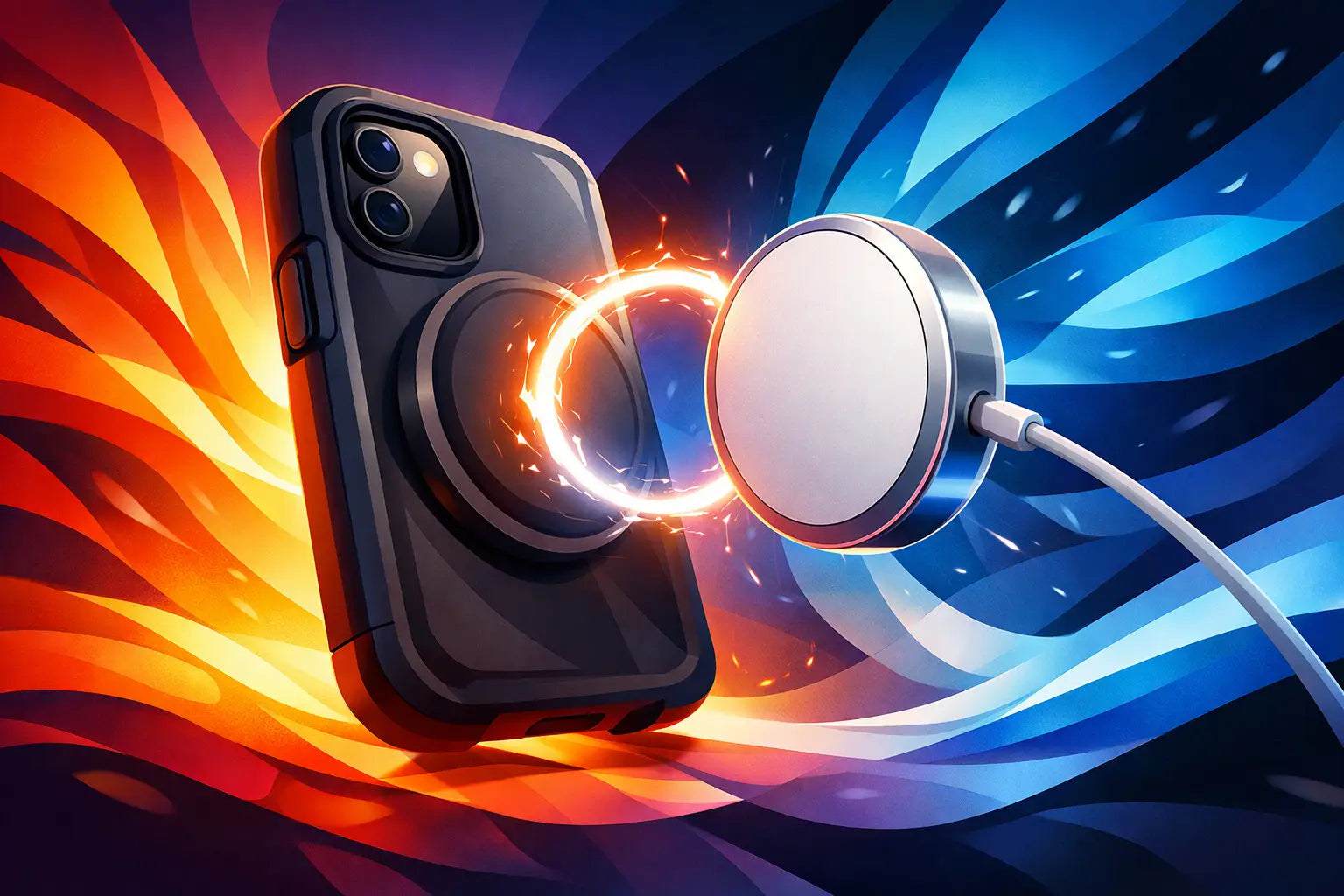
That snap is either satisfying or suspicious. If you’ve ever slapped a MagSafe charger or wallet onto your phone and felt a weak hold, the question gets real fast: does MagSafe work with thick cases? The short answer is yes, but only when the case is designed for it. Thickness alone is not the whole story. Magnet strength, material, and how the case is built matter just as much.
Does MagSafe work with thick cases, really?
It can, but there’s a limit.
MagSafe works through magnets and wireless charging coils that need to line up closely with your iPhone. Add too much material between the phone and the accessory, and that magnetic connection gets weaker. Wireless charging can still happen in some thick cases, but the snap may feel less secure, charging may run slower, and accessories like wallets, ring holders, or power banks may shift more than you want.
A thick case that is specifically made to be MagSafe-compatible is a very different story from a generic thick case. A proper MagSafe case usually has a built-in magnetic ring aligned to the iPhone’s internal magnets. That extra ring helps restore the pull you lose when more material sits between the phone and the accessory.
So if you’re wondering whether thick protection and MagSafe can coexist, the answer is yes - as long as the case was engineered for both.
What actually affects MagSafe performance?
People often assume the only issue is bulk. In reality, three things decide whether MagSafe feels strong or frustrating.
Case thickness
The farther the accessory sits from the iPhone’s internal magnet array, the weaker the magnetic hold becomes. This is simple physics. A slim case usually gives MagSafe the easiest path to work well. A thicker case adds distance, which can reduce both grip and charging efficiency.
That said, not every thick case performs poorly. If the case includes strong, well-placed magnets, it can still hold a charger or wallet securely enough for everyday use.
Case material
Materials change the experience more than most people expect. Soft silicone, TPU, polycarbonate, and hybrid constructions all behave differently. Thick leather-style layers, heavy padding, or extra decorative elements can create more separation between the phone and MagSafe accessories.
Metal is where things get messy. If a case has metal plates, kickstands, or magnetic patches that are not part of a proper MagSafe ring, it can interfere with charging or attachment. That’s why a case can feel protective and premium but still be awful with MagSafe.
Magnet alignment
A thick case without built-in magnets is asking MagSafe to do all the work through extra layers. Sometimes it will still charge. Sometimes the accessory will attach, but weakly. Sometimes it will slide off the second you pick up your phone.
A thick MagSafe-compatible case solves that by matching the ring placement to the iPhone’s internal layout. Alignment is what turns “kind of works” into “actually works.”
How thick is too thick for MagSafe?
There’s no single magic number because construction matters, but once a case gets noticeably chunky, MagSafe performance starts depending heavily on the quality of the magnet ring. Thin to medium cases generally cause fewer issues. Extra-rugged cases with reinforced corners, multilayer backs, or built-in storage are more likely to weaken the connection unless they were designed around MagSafe from the start.
If you use MagSafe only for overnight charging on a flat surface, you can get away with more thickness. If you want a wallet that stays put in your pocket, a ring holder that feels solid, or a car mount that won’t drop your phone on a hard turn, magnetic strength matters a lot more.
That’s the trade-off. More protection often means more material, and more material can reduce MagSafe performance unless the magnets are strong enough to compensate.
Signs your thick case is hurting MagSafe
You do not need lab equipment to figure this out. Real-world use tells you pretty quickly.
If the charger keeps disconnecting when you move the phone, the magnetic hold is probably too weak. If your battery pack slides around in your bag, the ring connection is not strong enough. If your wallet rotates too easily or falls off when pulling the phone from your pocket, the case is likely too thick, not properly magnetized, or both.
Another common sign is heat. Wireless charging naturally creates some warmth, but if charging feels unusually inconsistent or hot through a thick case, the added distance may be making the charger work harder than it should.
Thick cases that still work well with MagSafe
The sweet spot is a protective case that keeps a confident profile without becoming a brick. A well-made MagSafe case can absolutely have raised edges, shock-absorbing corners, and durable materials while still letting accessories snap on the way they should.
Look for language that clearly says MagSafe-compatible, not just wireless charging compatible. Those are not the same thing. A case may support standard wireless charging but have no useful magnetic hold at all. If you want the full MagSafe experience, the case needs built-in magnets, not vague compatibility claims.
This is where design quality shows up fast. Strong embedded magnets, precise ring placement, and materials that do not block performance make all the difference. Stylish cases do not have to act delicate, and protective cases do not have to ruin the clean snap MagSafe is known for.
Does MagSafe charging still work if the case is thick?
Usually, yes - but not always at full strength.
Wireless charging is more forgiving than magnetic attachment. Your phone may still charge through a thicker case even if the magnetic grip feels weaker. But speed and consistency can drop when the charger sits farther from the charging coil.
That’s why some people say their thick case “works with MagSafe” when they really mean the phone charges if left alone on a puck. That is different from having a secure magnetic connection for charging while texting, carrying, or using accessories.
If you use a MagSafe power bank, this difference matters even more. A weak magnetic hold plus movement equals interrupted charging. A stronger MagSafe case makes portable charging a lot less annoying.
Accessories are less forgiving than chargers
Here’s the part many buyers miss: chargers and accessories do not ask the same thing from your case.
A desk charger only needs enough alignment to transfer power. A wallet, car mount, ring holder, or battery pack needs enough magnetic grip to stay attached under movement. That means a thick case that is “fine” for charging can still be disappointing for accessories.
So when asking does MagSafe work with thick cases, the better follow-up is: for what? Overnight charging, maybe. A car mount during your commute, maybe not. A battery pack on the go, only if the magnets are strong and the case was made for it.
How to choose a thick case without ruining MagSafe
If you want protection and the MagSafe snap, be picky.
Start with a case that explicitly supports MagSafe and has built-in magnets. After that, check the overall back design. Very textured backs, extra-thick decorative layers, or add-ons built into the center of the case can all affect attachment. If your style leans bold, the good news is you do not have to settle for plain. Brands like CASETEROID build MagSafe-compatible cases that keep the look sharp without treating function like an afterthought.
Also think about how you actually use your phone. If you mostly care about drop protection and only occasionally use wireless charging, a thicker case with moderate MagSafe performance may be perfectly fine. If you live on magnetic mounts, power banks, and wallets, choose magnet strength over maximum bulk.
The smartest buy is not the thickest case. It’s the one that gives you enough protection for your routine without making your accessories feel unreliable.
The real answer
MagSafe can work with thick cases, but “can” is doing a lot of work there. A thick case with no magnetic engineering often gives you a weak snap and uneven charging. A thick case built for MagSafe can still feel secure, practical, and easy to use.
If your case is getting in the way, you’ll notice it fast. The charger shifts. The wallet slips. The battery pack disconnects. That’s your sign that thickness has crossed from protective to inconvenient.
Good design changes everything. When the magnets are strong, the materials are chosen well, and the case is built with MagSafe in mind, you do not have to choose between protection and that clean magnetic click. You just need a case that respects both.
Buy 2 Get 2 Free Phone Case Deals That Win
Phone Case for Wireless Charging Alignment