
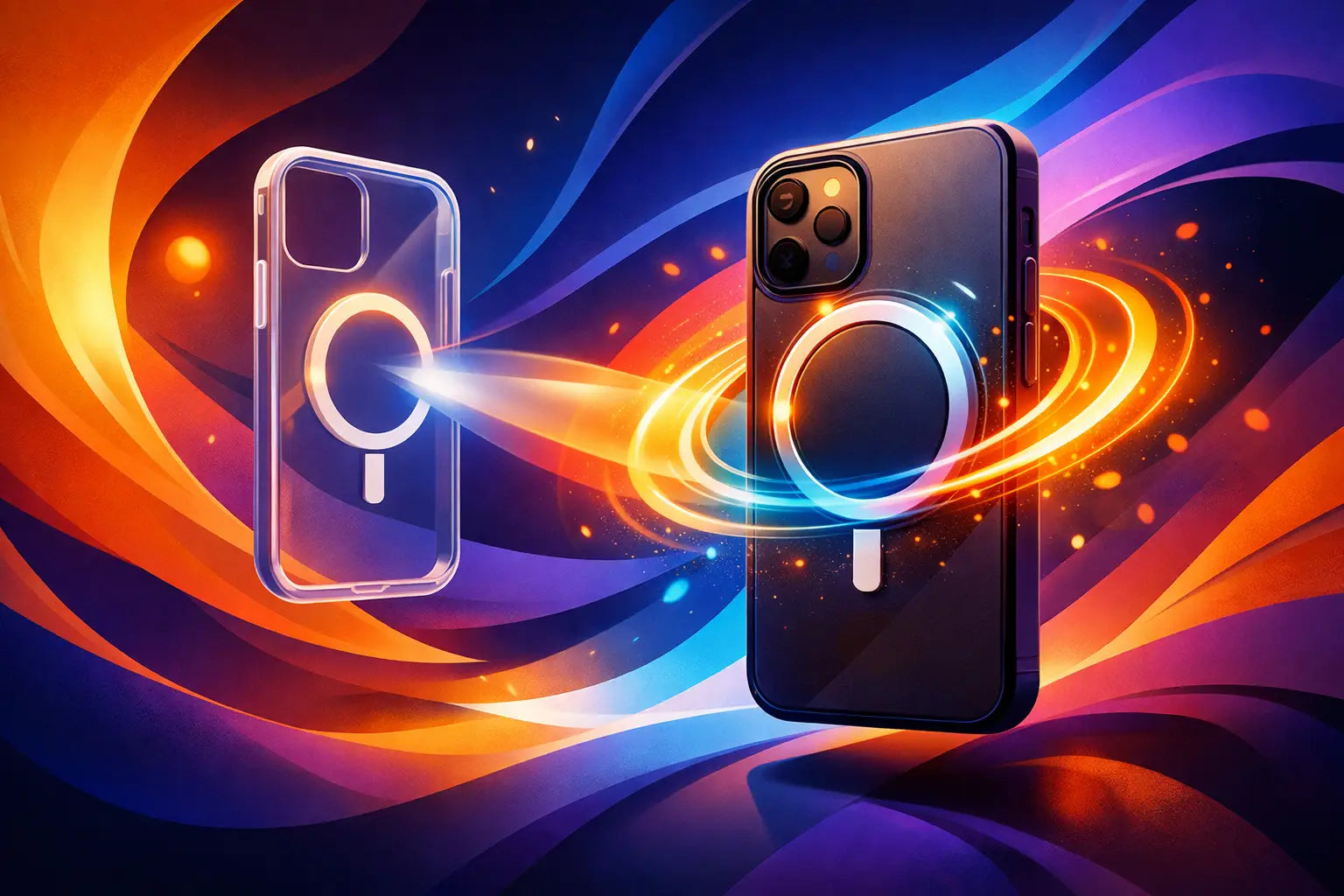
You snap your charger onto the back of your iPhone, expect that clean magnetic click, and instead get a weak connection, slow charging, or a wallet that slides right off. So, does MagSafe work through cases? Yes, but not through every case - and the difference usually comes down to thickness, materials, and whether the case was actually built for MagSafe.
That means the answer is less about Apple marketing and more about physics. If you want MagSafe accessories to stay put and charge reliably, the case matters just as much as the phone.
Does MagSafe work through cases in real life?
In real-world use, MagSafe works through cases when the case is thin enough and includes the right magnetic alignment. A MagSafe-compatible case is designed to let the charger or accessory connect to the iPhone’s internal magnet ring without too much interference. When that alignment is right, charging feels easy and accessories lock on with a lot more confidence.
When the case is too thick, made with the wrong materials, or missing its own magnetic ring, the connection gets weaker. Sometimes charging still starts, but it can be inconsistent. Sometimes the charger attaches but slips off more easily. And sometimes a MagSafe wallet or power bank will technically connect, but not strongly enough to trust in a backpack, pocket, or quick grab off a desk.
That last part matters more than people think. MagSafe is not only about wireless charging. It is also about magnetic alignment, accessory grip, and daily convenience. If your case weakens those things, the whole point starts to fade.
What makes a case MagSafe-friendly?
A case that works well with MagSafe usually gets three things right. First, it keeps the back panel relatively slim so the charger is still close enough to the phone’s internal charging coil. Wireless charging loses efficiency as distance increases, so even a little extra bulk can matter.
Second, it uses magnets placed in the correct ring pattern. This is what helps the charger center itself and helps accessories attach in the right position. A plain case without magnets might still allow some wireless charging, but it will not deliver the same snap-on experience.
Third, it avoids materials that interfere with the magnetic connection. Most standard TPU and polycarbonate cases are fine if they are designed properly. Thick layered builds, metal components, or bulky add-ons on the back can be a problem.
A good MagSafe case is basically balancing protection and precision. Too little structure and it feels cheap. Too much bulk and the magnetic performance drops.
Thickness is the first thing to watch
If a case feels extra chunky, MagSafe may struggle. This does not mean protective cases are automatically bad. It just means there is a limit. Slim to moderately protective cases can still work great with MagSafe, especially when they are built with a magnetic ring inside.
Ultra-rugged cases can be hit or miss. Some are engineered for MagSafe and still perform well, but others put too much material between the charger and the phone. If you are using a case mainly for style and everyday protection, you have a much better shot at strong MagSafe performance than if you are using a heavy-duty shell with thick corners and layered backing.
The magnetic ring matters more than the label
A lot of cases say they support wireless charging. That is not the same thing as being truly MagSafe-compatible. Wireless charging support only means power can pass through the case. MagSafe compatibility means magnets are built in to improve attachment, alignment, and stability.
This is where shoppers get tripped up. A case can technically charge on a wireless pad and still be annoying with MagSafe accessories. If the charger slides around, disconnects easily, or barely holds a wallet, the case is not doing the full job.
Cases that usually work best with MagSafe
The most reliable option is a case designed specifically for MagSafe. These cases have embedded magnets that match the iPhone’s magnetic array and keep the connection strong enough for chargers, wallets, ring holders, and power banks.
Slim hard-shell cases and flexible hybrid cases tend to do especially well. They are protective without putting too much distance between the phone and the accessory. Fashion-forward cases can also perform really well here, as long as the design does not add thick textures, metal plates, or raised back elements in the charging area.
Clear cases, printed cases, and matte finish cases can all work with MagSafe. The finish itself is not the issue. The real question is what is happening underneath that finish.
If you want style and function in the same package, this is exactly where a purpose-built case earns its keep. CASETEROID focuses on designs that look bold and still play nicely with MagSafe accessories, which is the sweet spot for people who do not want their phone setup to look basic just to stay practical.
Cases that can weaken MagSafe performance
The biggest red flags are thick materials, metal parts, and anything attached to the back of the case. Kickstands, card holders, finger grips, and decorative hardware can interfere with charging or make magnetic accessories useless.
Very rugged cases are another common issue. Some are excellent, but many trade magnetic strength for maximum bulk. If you drop your phone on hiking trails every weekend, that may be worth it. If your phone mostly lives in your hand, pocket, car mount, and coffee shop, a more balanced case often makes more sense.
Cheap cases with weak built-in magnets can also disappoint. On paper they are MagSafe-compatible. In practice they feel loose, especially with heavier accessories like battery packs. A charger might still attach, but if you can knock it off with barely any force, that connection is not doing much for your day-to-day use.
Decorative features can get in the way
Raised patterns, thick glitter layers, pop-out accents, and metal camera surround pieces can all affect how flat the charger sits. Even if the case looks great, MagSafe needs clean contact and close alignment. A little visual drama is fine. A big lump in the center of the case is usually not.
That does not mean stylish cases are off the table. It just means the design has to be smart. A case can absolutely be expressive and still MagSafe-ready if the magnetic zone stays functional.
How to tell if your case will work well
If you already own a case, the easiest test is simple. Attach a MagSafe charger or accessory and pay attention to how it feels. A strong connection should snap into place with clear alignment. It should not slide around too easily. Charging should begin quickly and stay connected when you pick up the phone gently.
If you are using a MagSafe wallet or power bank, check whether it stays attached during normal movement. If it shifts every time you pull the phone from your pocket or toss it on a seat, the magnetic hold is probably too weak.
Heat can be another clue. Wireless charging naturally creates some warmth, but if your phone gets noticeably hot through the case or charging keeps starting and stopping, the case may be adding too much distance or interference.
What if your case is not MagSafe-compatible?
If your case is not MagSafe-compatible, standard wireless charging may still work, especially with thinner cases. You just lose the magnetic alignment and stronger grip that make MagSafe feel better in everyday use.
That can be fine if you only use a flat charging pad at night. But if you want the full setup - magnetic charger, battery pack, car mount, wallet, ring holder - a non-MagSafe case usually becomes the weak link.
Some people try adhesive magnet rings as a workaround. They can help, but results vary. The look is not always clean, the hold is not always great, and lower-quality rings can peel or shift over time. If you care about both performance and aesthetics, a properly built MagSafe case is usually the better move.
Is a MagSafe case worth it?
If you use MagSafe more than once in a while, yes. A real MagSafe-compatible case makes the whole system feel more reliable. Chargers line up faster, accessories stay attached better, and you spend less time fiddling with your phone setup.
It is especially worth it if you use your phone on the go. A magnetic power bank that keeps slipping is annoying. A car mount that feels shaky is worse. The right case removes that friction.
The trade-off is that not every protective or decorative case will deliver the same magnetic strength. If your top priority is extreme protection or oversized case features, you may need to accept weaker MagSafe performance. But for most people, there is a very workable middle ground where style, protection, and magnetic function all fit together.
So, does MagSafe work through cases? Absolutely - when the case is made for it. Choose one that is slim enough, magnetically aligned, and free of back-panel obstacles, and MagSafe feels as good as it should. Your phone case should not be the thing holding your accessories back.
8 MagSafe Case Alignment Tips That Work
Ring Holder vs Pop Socket: Which Wins?